Country profile: Portugal |
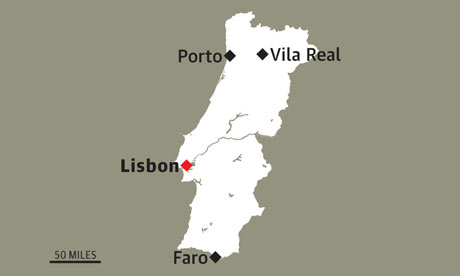
Map of Portugal. Source: Graphic Potted history of the country: The oldest European nation state, Portugal had attained its present extent by the mid-13th century. In the early 14th century Portugal begun its worldwide exploration, which gave it a global empire and extensive wealth but isolated it from the rest of Europe. Long ruled by a tiny oligarchy, in 1910 a republic was proclaimed, followed by six decades of repressive government until a left-wing coup in 1974 brought reform.
Political pressure points: Portugal is a democratic republic. Its current president is Aníbal Cavaco Silva, who began his five-year term in 2006. In December, the former president Mario Soares warned that rising social inequality, an expected large increase in unemployment, the impunity of bankers and inequities in the justice system are creating a climate of distrust and revolt. Population mix: Majority Portuguese small minority Brazilian and African communities Religious makeup: Catholic 84.5%, other Christian 2.2%, none 3.9% Main languages: Portuguese Living national icons: José Saramago (author), Mariza (fado singer), Paula Rego (artist), Herman José (comedian), Manoel de Oliveira (film director), Maria de Medeiros (actor) Cristiano Ronaldo (footballer), Simao Sabrosa (footballer)  Portugal on a map. Source: Graphic Portugal on a map. Source: Graphic
Landscape and climate: On the western tip of the Iberian peninsula bordered by Spain and the Atlantic, the south is warm and dry with gently rolling hills and plains and the famous sandy beaches of the Algarve. The central area consists of dunes and pine forests, whereas the north is rugged and mountainous, and cool and rainy. Highest point: Pico, in the Azores, 2,351 metres Area covered by water: 169 square miles Healthcare and disease: Portugal has a large national health service with universal coverage funded by employer and employee contributions. Death from cardiovascular diseases is higher than elsewhere in Europe, but death from cancer is lower. There is a high incidence of diabetes and the other main cause of natural death is respiratory disorders. Average life expectancy (m/f): 75/82 Average number of children per mother: 1.5 Maternal deaths per 100,000 live births: 11 Infant deaths per 1,000 births: 4 HIV/Aids rate: 0.4% Doctors per 1,000 head of population: 3.4 Adult literacy rate: 94.9% (m 96.68%; f 93.3%) Economic outlook: Dubious. Although the budget deficit was decreased to 2.6% of GDP in 2007, growth was a mere 0.9% last year and the government is struggling to keep the deficit below the 3% of GDP ceiling set by the EU. Main industries: Tourism, textiles, clothing, footwear, glass, ceramics, metal goods, wine and port Key crops/livestock: Fruit, tomatoes, potatoes, maize, sugar beet, olives, wheat Key exports: Textiles, clothing, footwear, machinery, transport equipment, mineral products, base metals, port GDP: £99,444m (35th) GDP per head: £9,391 Unemployment rate: 8% Proportion of global carbon emissions: 0.21% Most popular tourist attractions: Cities of Lisbon and Oporto, town of Sintra, the Algarve coast, the island of Madeira. Local recommendation: Take the train from Faro to the town of Tavira, from where a boat goes to the beach island of the same name. Frequented by locals by day, by night it is just you and a few other campers Traditional dish: Bacalhau (salted cod) Foreign tourist visitors per year: 6,976,978 Media freedom index (ranked out of 173): 16 Did you know ... King Manuel II, Portugal's last king, was deposed in 1910 and lived in exile in Twickenham in England, where he died in 1932. National anthem: · Information correct on date of first publication, Thursday 23 April 2009. |